


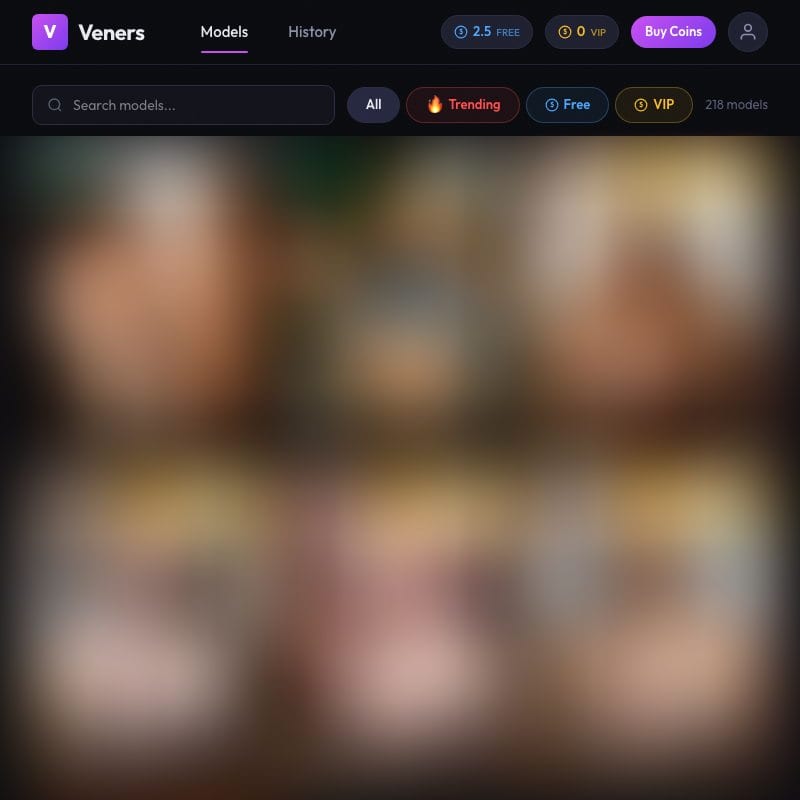
About the evidence. This Veners AI review works from a supplied write-up, its product data, and the catalogue capture above. The capture date is unknown. Prices, model counts, and realism claims belong to that material, and nothing here comes from an account, a purchase, or a generation test.
What is Veners AI?
Veners is the narrowest tool in this series and the clearest about it. You upload one photograph, choose one of 218 pre-trained animation templates, and receive a short explicit clip of between five and twenty seconds. There is no prompt box, no inpainting, no upscaler, no chat, and no way to combine templates into anything longer.
That makes it a different proposition from the undress tools around it. Most of them sell a capability and let you point it at whatever you like. This one sells a catalogue of finished outcomes, and the only decision you make is which one to buy.
The catalogue is the product
The capture shows the whole interface: a search field, filters for all, trending, free, and VIP, a coin balance, a Buy Coins button, and the count that defines the service, 218 models.
| Element | What it shows |
|---|---|
| Catalogue size | 218 models, each with roughly two to six variants |
| Card metadata | Coin price, clip duration, variant count, and quality tags |
| Balance | 2.5 free coins and 0 VIP coins on the account shown |
| Filters | All, trending, free, and VIP |
| Navigation | Models and History only |
| Entry models | Two cheapest templates carry free labels at 1.8 and 2 coins |
We describe the template subjects by category rather than reproducing their names, which are explicit.
Variants are the second axis. A single model might offer a different camera angle, an added finish, or synchronised audio, which means the real catalogue is several hundred permutations rather than 218. Quality tags mark the ultra-realistic versions and the ones with sound. All of that is the provider’s own labelling, applied by the provider to its own products.
Undress is inside the animation, not a button
This is the one genuinely distinct piece of engineering here. Every other tool in this series treats undressing as a static edit, and motion, where it exists at all, is a separate step applied afterwards. Veners builds the clothing removal into the animation itself: one entry level template lifts fabric and animates what is underneath, while the more advanced ones skip the reveal entirely and put the uploaded likeness straight into motion.
Doing it in one pass is harder than doing it in two, and it avoids the failure mode the other tools all share, where a flaw in the still gets amplified once it moves. It also removes any control you might have had. There is no mask, no slider, no correction pass. The template decides what happens, and the only variable you supply is the photograph.
Realism claims, and what actually backs them
The catalogue leans on ultra-realistic as a label, applied by the provider to its own higher tier models. The source describes emphasis on skin texture, motion blur, hair movement, and fluid physics, with audio on some variants.
One structural advantage is real: because everything derives from a single uploaded photo, the face and proportions stay consistent for the whole clip. Open ended generators drift; a five to twenty second template applied to one still has much less room to.
What is missing is any way to check the rest. The source notes there is no substantial public gallery of user output, so the claims rest on promotional stills and the provider’s own tags. No sample, failure rate, or test record appears in the material, and we ran none. Treat every realism claim here as marketing until you have spent coins of your own.
Coins, and the price you cannot see
Veners charges per generation rather than by subscription. Every card carries a coin price, and the reported ladder scales with duration.
| Clip | Reported coins | Coins per second |
|---|---|---|
| Entry templates | 1.8 and 2 | Labelled free |
| 5 seconds | About 2.6 | ~0.52 |
| 10 seconds | About 5 | ~0.50 |
| 15 seconds | About 8 | ~0.53 |
| 20 seconds or multi variant | 12 and up | ~0.60 |
Coins per second is our arithmetic from the reported prices. What a coin costs in money is not published.
Two things fall out of that. First, there is no volume discount: a twenty second clip costs slightly more per second than a five second one, so length is charged linearly and then some. Second, and more importantly, the entire price list is denominated in a currency with no published exchange rate. The source says the conversion appears only at the purchase screen, which means you cannot compare this tool to any other, or even judge whether a twelve coin template is expensive, until you are already at checkout.
The free balance deserves a note of its own. The account in the capture holds 2.5 coins, which covers one of the two entry templates and falls just short of the cheapest ultra-realistic five second model at about 2.6. The sample is calibrated to stop exactly before the thing the site is selling.
The missing policy pages
Here is the part that should decide whether you use this service. Veners asks for a photograph of a face as its only input, and the supplied material reports that privacy terms, data retention, refund policy, and ownership of generated content are not clearly presented on the public pages.
Every other tool in this series at least states a position, however unverified: a retention claim, a refund window, an acceptable use policy. A service that takes intimate uploads and publishes none of that is asking for more trust than its competitors while offering less documentation than any of them. The absence is the finding.
The site frames its content as fantasy entertainment involving consenting or synthetic subjects, which is the correct framing. It does not change the rule that applies to every tool here: generating sexual images of a real person without their consent is unlawful in a growing number of jurisdictions, including under UK law and several US state laws. With no visible policy on what happens to an upload after processing, that risk sits entirely with the person who uploads.
Pros and cons
Reported strengths
- Undress is animated inside the template rather than bolted onto a still, which avoids a two step quality loss
- One uploaded photo carries a consistent face and proportions through the whole clip
- Every card shows duration, variant count and price before you commit anything
- Pay per clip with no subscription, and two entry templates priced as free samples
Open problems
- Prices are in coins with no published money conversion until checkout, and longer clips cost more per second rather than less
- Privacy, retention, refund and ownership terms are not surfaced publicly on a service whose only input is a photograph of a face
Verdict: who Veners is for
It knows exactly what it sells.
It will not tell you the price.
Veners AI is a vending machine for one kind of output, and it is unusually good at being one. Building the undress into the animation is a real technical choice rather than a feature list entry, the single photo input keeps a character consistent, and the catalogue removes every decision except which scenario you want.
What it withholds is everything a buyer needs. A coin price with no exchange rate is not a price, a free balance that stops short of the cheapest real model is a sample designed not to satisfy, and a site built on uploaded faces should publish its retention and refund terms before it asks for one. If a specific template is exactly what you want, check what a coin costs before you buy any, and upload nothing you would not want kept. We assign no score without testing.
Veners FAQ
How much does Veners cost?
Prices are shown in coins on each card: roughly 2.6 for a five second clip, 5 for ten seconds, 8 for fifteen, and 12 or more for twenty seconds or multi variant packs. The money value of a coin is not published on the catalogue and appears at the purchase screen.
Is Veners free?
New accounts are reported to start with a small balance, 2.5 coins on the account in our capture, and two entry templates carry free labels at 1.8 and 2 coins. That covers one sample and stops just below the cheapest ultra-realistic model.
How long are Veners clips?
Between five and twenty seconds, with the duration marked on every card. There is no way to chain templates into anything longer.
Can I control the pose or the scene?
No. The template decides everything except the photograph you upload. Variants offer a fixed set of alternatives such as a different camera angle or an added finish, and there is no prompt field, mask, or correction pass.
What happens to a photo I upload?
The supplied material reports that retention and privacy terms are not clearly presented on the public pages, so there is no documented answer. Treat any upload as data you cannot get back, and use synthetic images or images of adults who have agreed.
Sources: a supplied Veners write-up and product data, and the catalogue capture shown above. The mark and wordmark are taken from the capture header, since the only icon file served by veners.ai is a generic placeholder. The capture is unmodified except for the blur we applied to its template thumbnails; the header, filters and model count are untouched. Coins per second are our arithmetic from reported prices. Explicit template names are described by category rather than reproduced. The Visit site button is a tracked affiliate link: a signup or purchase through it may earn us a commission, which did not change a word of this review.
Prepared by Fantasy AI Tools.
Read our editorial approach